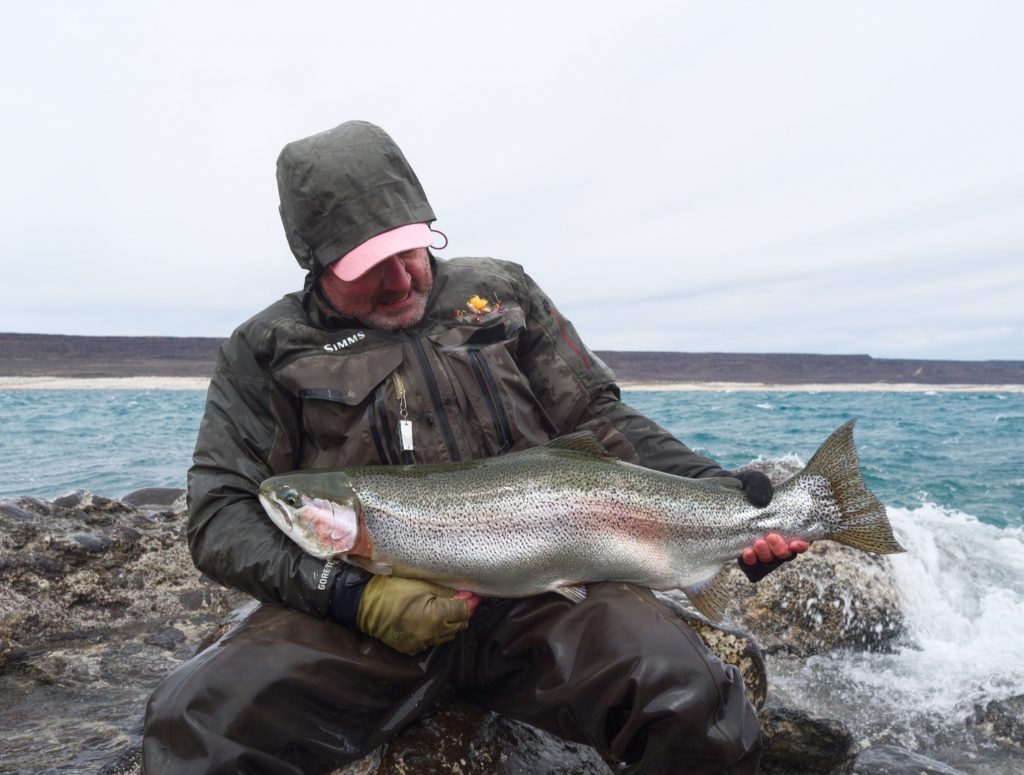
Member Clem Booth has recently returned from Patagonia, where he caught this stunning wild rainbow trout. These fish migrate between Lake (Lago Strobel) and river and as can be seen from the photo are similar to steelhead in appearance.
This one weighed 19lbs and measured 34 inches. Not quite Clem’s best however. In 2018 he had a 20 pounder.
Last year it was decided not to have the annual dinner on the same night as the AGM as usual but possibly to have the dinner some time in the new year. This has now been arranged and it will take place on Friday March 6th, 7.30 pm, at the Dartmoor Lodge Hotel by way of a pre-season dinner and get-together. Members and their guests are cordially invited. As in former years, riparian owners, DAA members and other local association members will also be present at the invitation of the Association.
Menus and booking forms have been sent out to members. If attending, please return your completed booking form with choice of meals and a cheque for £25 pp to the Hon Sec. ASAP.
Previous attempts have been made with varying success to keep members up to date by email, being quicker and cheaper than by post. However this can only work if members keep their contact details updated with the Hon Sec. It is particularly disappointing when emails are sent out and back come a clutch of non-delivery notices, due to out of date or incorrect email addresses. Please could members not in frequent email contact with Hon Sec please check with him that he has your up-to-date contact info?
Unfortunately, the turnout for Sunday’s bank clearing session was extremely underwhelming. This work is essential and lack of it will impact on members fishing. Having said that, these sessions tend to be quite social and people have even been known to have fun while getting a bit of post Christmas exercise. Please come along if you can.
The next session is this Sunday 12th Jan – Abbots Mead to Quarry Pool (CC) – RV Abbots Mead
“Somewhere on their journey, wild salmon numbers are being decimated. For every 100 salmon that leave our rivers for the sea, less than five return – a decline of nearly 70% in just 25 years.” – AST
We have known for some time that salmon are facing big problems at sea and indeed they could become an endangered species in our lifetime. In order to quantify these impacts on the salmon population the Atlantic Salmon Trust have a project underway to tack smolts from rivers that open to the Moray Firth. 20% of salmon leaving UK rivers do so by this route. The insights gained should be transferable to other salmon populations around the UK.
Bank clearing time is here once more and again under the supervision of Robin Thorn. Please come along and help with this essential work if you can. Newer members are particularly welcome and may find the sessions useful in getting to know the river and fellow members.
Dates and places are as follows. All sessions commence at 0930 and are subject to river height and weather conditions.
Sunday 5th Jan- Caddaford to Abbots Mead (CC)
Sunday 12th Jan- Abbots Mead to Quarry Pool (CC)
Sunday 19th Jan- Kilbury Weir (above) to Austin’s Bridge
Sunday 26th Jan- Austin’s Bridge to Caddaford (CC)
Sunday 2nd Feb- Fogdens + Nursery (SWW)
Sunday 9th Feb- Hembury CANCELLED
Sunday 16th Feb- Quarry Pool to Davey’s Pit (CC)CANCELLED
Sunday 23th Feb- Hangman’s Pool to Park Stickle (CC)
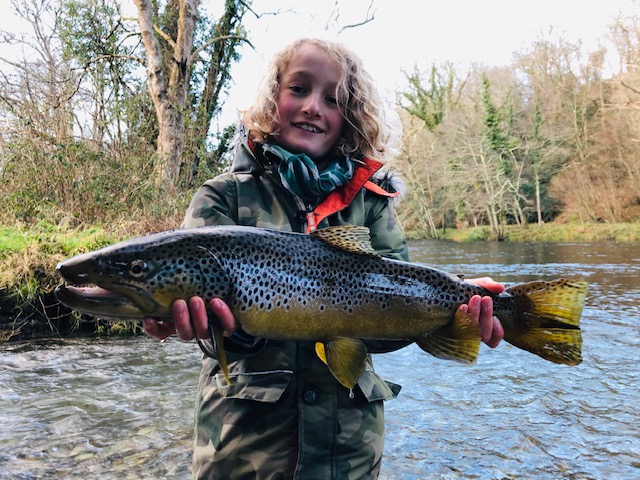
Lest we get carried away with the idea that the Dart is all about Sea Trout, here is a reminder that there are some really good Brown Trout in our river.
Brown Trout 4lbs 6oz taken on fly by DAA member May 2019, River Dart.
The following is a link to a BBC news article prompted by the WWF charity’s warning that our rivers are being “used as open sewers”. At present, it states, only 21% of south west rivers reach ‘good’ environmental standards. We seem to be rather more fortunate than the Thames area, where the figure is 3%. However, we do have the highest rates of pollution incidents here in the south west.
The DFA is part of the Anglers’ Riverfly Monitoring Initiative ( ARMI ). This initiative involves anglers like us in monitoring the biological health of their home river by sampling the numbers of selected invertebrates present at intervals throughout the year. Importantly, these data can give early warning of pollution incidents and lowering of water quality.
At the moment the Association has only one team of two volunteers, both from the DAA, who cover four locations on the Dart. They were out recently at Fogdens, where a healthy count of olive, caddis, stonefly and Heptageniidae larvae was made.
Some of the larvae sorted by type and ready to be counted. Clockwise from top: (empty), BWO, olives, stonefly, caseless caddis, Heptageniidae, (unidentified), cased caddis.
We could do with at least one more team of volunteers to give more coverage to the river. It is possible to operate as a team of one, but two is ideal. Volunteers attend an official one-day Riverfly Partnership workshop, run by an accredited Riverfly Partnership Tutor. The workshop includes presentations and practical demonstrations. Subsequently they would choose a site or number of sites, which, when approved, they would proceed to monitor.
The count at Fogdens was made a little more difficult by some of our ‘catch’ of olives turning into adults and flying away!
If you feel you would like to become involved in this interesting work please contact the River Dart Coordinator Luke, at riverfly@dartaa.org.uk